
 By
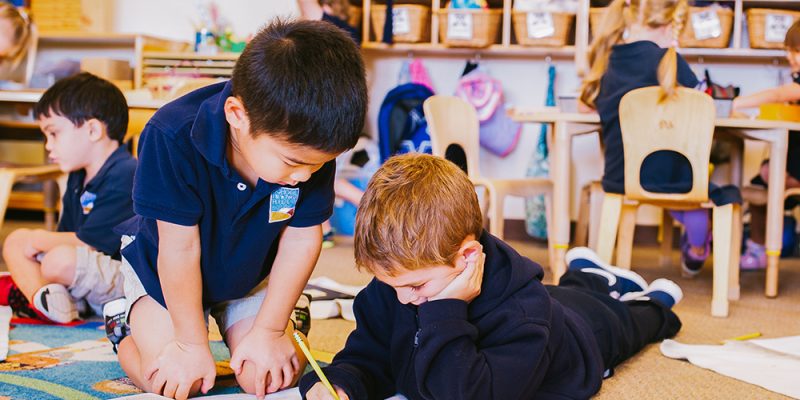
Around the age of six, a child who once asked “what is this?” starts asking “why?” Why does the moon change shape? Why do some people get more than others? Who decided that this word means this thing? The questions get bigger, and the child’s patience with simple answers gets shorter.
For parents weighing the benefits of Montessori education for primary students, this shift is the place to start. Montessori elementary, for children aged six to twelve, is not the Children’s House with complex and harder materials. It is designed around a different kind of mind. This guide explains what changes at six, how project work grows out of that change, how learning is assessed without grades, and what the research does and does not show.
Ideas like these are easier to judge when you can see them in practice. So alongside the general principles, this guide follows one Hyderabad school, Blue Blocks Montessori School, which runs a six-to-twelve programme, to show what each idea can look like in a real classroom. Every school implements Montessori differently, and the questions here apply wherever you look.
One note on terms: in Montessori language, ‘Primary’ often refers to the three-to-six years, while Indian schools use it for Class 1 onwards. Schools describing their six-to-twelve programme usually call it ‘Elementary’. Blue Blocks, for example, uses ‘Elementary’ for Grades 1 to 6. It is worth checking which stage any school means.
The second plane: a reasoning, social, moral mind
Maria Montessori described development in four planes, each with its own character. The first, from birth to six, is about absorbing the world. The second, from six to twelve, is about understanding it.
She observed several changes in children at this stage:
Reasoning. The child wants causes and connections, not just facts.
Imagination. The child can now picture what they cannot see: the distant past, other countries, the scale of the universe.
A sense of fairness. Questions of right and wrong, rules and justice become deeply important. Arguments about whether a game was fair are not distractions; they are moral development at work.
A strong pull towards the group. Children want to work with friends, organise themselves and belong.
These are Montessori’s observations, used as a framework rather than a timetable. But they explain why an elementary classroom designed around them looks so different from one designed around worksheets and individual desks. Schools that build on this framework often name the shift directly. Blue Blocks, for instance, describes the elementary child’s inner request as “Help me to understand for myself.”
Starting with the universe
Montessori’s answer to the reasoning mind was what she called cosmic education. Instead of beginning with the child’s immediate surroundings and moving outwards subject by subject, the elementary years begin with the largest story available: how the universe came to be, how life emerged, how humans arrived, and how people invented writing and numbers.
These are usually told as five ‘Great Stories’ at the start of the year. They are not lessons to memorise. They are meant to open questions. A child who hears how early humans first recorded numbers may want to know how different cultures counted, which leads to number systems, then to place value, then to their own mathematical work. Subjects connect because the questions connect.
The elementary years do not begin with a timetable of subjects. They begin with a question big enough to need all of them.
How project work actually happens
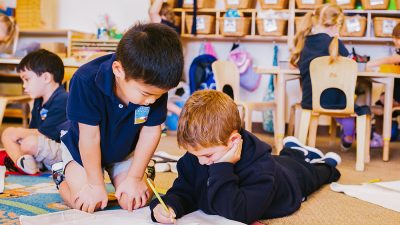
In a well-run Montessori elementary class, project work is not an add-on reserved for Friday afternoons. It grows from the child’s own questions, and it is usually done with others, because the second-plane child wants to work in a group.
A project might start with a Great Story, a material, or something a child noticed outside. Children research it, record what they find, and present it to their classmates. Some projects stay small. Others grow into extended, collaborative pieces of work lasting weeks: a mathematical investigation, a research study, a dramatic production.
The Montessori tradition also includes ‘Going Out’. These are small-group expeditions to museums, experts, field sites or community organisations, planned largely by the children themselves. They write the letters, prepare the questions, arrange the logistics and report back. The point is not the outing. It is the planning, the responsibility and the experience of finding things out from the real world.
When a child’s questions grow beyond what the shelves hold, some schools give them room to explore further. In Indian schools, “primary” usually means the classes from Class 1 onwards, while in Montessori it refers to the 3-6 years. Families searching for “montessori primary school hyderabad” are usually looking for the first meaning, which Blue Blocks calls its Elementary programme, for ages 6 to 12 at the Tellapur campus. There, learning is driven by the child’s own research and interests, and children’s studies connect to the natural and social world around them. Ask to see recent examples of this work and how it connects to everyday lessons.Assessment without grades: what parents should ask
This is the part of Montessori elementary that most unsettles parents, and reasonably so. Many programmes give no tests and no grades in the elementary years. So how does anyone know a child is learning?
In practice, assessment becomes continuous and observation-based rather than periodic and test-based. The guide records which presentations a child has received, what work followed, and when a concept has been mastered. Children keep work journals and meet the guide individually to review progress and plan what comes next. Completed work is collected over time.
The Montessori elementary classes 1-6 at Blue Blocks show what this looks like when a school commits to it fully. There are no board exams at this level. Individual guide-child conferences are the main feedback mechanism. Parents receive structured observation-based reports and parent-guide conferences in place of grades or rankings.
A system like this can be rigorous, but it depends entirely on how well it is done. Whether you are visiting Blue Blocks or any other Montessori elementary school in Hyderabad, these questions will tell you a great deal:
How are presentations and mastery recorded?
How often does my child meet the guide one-to-one to review their work?
What will I receive instead of a report card, and how often?
How would you notice if my child were avoiding a subject? Free choice works only if the guide spots and gently addresses avoidance.
When and how are children prepared for external assessment? Ask this especially about the later years.
Assessment without grades is not assessment without evidence. Ask to see the records.
Benefits of Montessori education for primary students: what research shows, and what it doesn’t
The most frequently cited study of Montessori elementary outcomes is a 2006 study in Science by Angeline Lillard and Nicole Else-Quest. It compared children who had won a lottery for a public Montessori school in the United States with children who had entered the same lottery but lost and attended other schools. This design helps account for the fact that families who seek out Montessori may differ from those who don’t.
Among the 12-year-olds (29 Montessori, 28 comparison), the Montessori children wrote essays rated as significantly more creative, with more sophisticated sentence structures. In social dilemmas, they were more likely to choose positive, assertive responses. They also reported a stronger sense of community at school.
So the honest reading of the benefits of Montessori education for primary students is this: the evidence suggests benefits in creative writing, social reasoning and belonging, without a cost to academic test performance.
Finding a Montessori School near the Financial District
In Hyderabad’s western corridor, Blue Blocks describes an elementary programme for Grades 1 to 6. Parents searching for “montessori elementary school hyderabad” may also review its dedicated Classes 1-6 page and ask the school to confirm current class groupings, project opportunities and how learning progress is communicated.
Whichever school you consider, ask to observe an elementary class at work. At Blue Blocks, the admissions process begins with a workshop where parents experience the environment. Watch whether children work together, pursue their own questions, and turn to a book or a classmate before the adult.
A brochure can describe the second plane; whereas a working classroom shows how a school has built a room for it.
Frequently asked questions
Do Montessori elementary children study mathematics and language?
Yes. Montessori elementary environments typically include language and mathematics alongside science, geography, history and cultural studies. Learning may be connected through projects rather than taught only as isolated textbook chapters. Parents should ask to see age-appropriate examples of work and how teachers check progress in each essential area.
How do guides know a child is progressing without frequent marks?
Progress can be documented through observations, lessons presented, completed work, portfolios, conversations and periodic assessments. The exact process varies by school. Ask which evidence is recorded, how often parents receive updates and what happens when a child needs additional help with a foundational skill.
What happens if a child keeps choosing only favourite activities?
Freedom in Montessori elementary education is not an absence of adult responsibility. Guides are expected to observe interests while ensuring children encounter essential learning areas. Ask how the teacher balances student choice with curriculum goals and how gaps in skills are identified and addressed.
Can Montessori elementary education prepare a child for a different secondary-school system?
A transition is possible, but readiness should be assessed against the destination school’s curriculum, assessments and classroom expectations. Parents can ask about written work, subject knowledge, study habits and transition support. No single school approach guarantees an effortless move for every child.





Comments