
 By
By 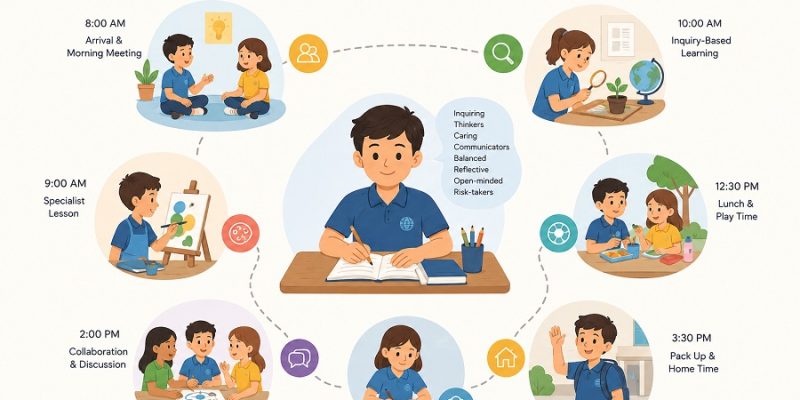
The early years of education play a vital role in shaping a child’s confidence, curiosity, and love for learning. A well-designed learning environment helps children develop not only academic knowledge but also essential life skills such as communication, collaboration, and critical thinking. Every school day becomes an opportunity to explore new ideas, ask meaningful questions, and build lasting connections with the world around them.
The PYP curriculum is designed to create engaging learning experiences that encourage children to become active participants in their education. Rather than focusing only on memorization, it inspires students to investigate, inquire, and discover concepts through hands-on activities and real-world experiences. Every lesson is thoughtfully planned to help children grow intellectually, socially, emotionally, and creatively while nurturing their natural curiosity.
Starting the Day with Purpose
A typical day begins with a warm and welcoming classroom environment where students feel safe, valued, and excited to learn. Morning discussions, classroom routines, and collaborative activities help children settle into the day while strengthening their communication and interpersonal skills.
Teachers encourage students to share their thoughts, ask questions, and express ideas confidently. These daily interactions foster independence and prepare children to become responsible learners.
Learning Through Inquiry
One of the defining features of the PYP curriculum is inquiry-based learning. Instead of simply receiving information, students explore topics by asking questions, conducting investigations, and finding solutions through observation and research.
For example, while learning about nature, students may observe plants, conduct simple experiments, or discuss how living things depend on one another. This interactive approach makes learning enjoyable and meaningful because children understand concepts through experience rather than memorization.
Inquiry-based learning also develops curiosity, creativity, and analytical thinking, helping students become lifelong learners.
Connecting Different Subjects
Rather than teaching every subject separately, the PYP curriculum integrates multiple areas of learning into meaningful units of inquiry. Mathematics, science, language, social studies, arts, and technology are often connected through common themes.
A lesson about communities, for instance, may include reading stories, writing reflections, creating artwork, studying geography, and solving mathematical problems related to the topic. This interdisciplinary approach helps students understand how knowledge connects across different subjects and real-life situations.
It also allows children to develop a deeper understanding of concepts instead of viewing each subject in isolation.
Building Essential Life Skills
Academic achievement is only one part of a child’s educational journey. Throughout the day, students participate in activities that strengthen important life skills such as teamwork, leadership, time management, problem-solving, and effective communication.
Group discussions, collaborative projects, presentations, and classroom responsibilities teach children how to work respectfully with others while appreciating different viewpoints. These experiences prepare students for future academic success and everyday challenges.
The learning environment also encourages children to become reflective thinkers who continuously evaluate their progress and identify opportunities for improvement.
Creativity and Self-Expression
Creative learning is an important aspect of every school day. Students engage in art, music, storytelling, drama, and design activities that encourage imagination and innovation.
These creative experiences allow children to express their thoughts in different ways while building confidence and emotional awareness. Whether creating artwork inspired by a classroom topic or performing in group presentations, students develop valuable communication and presentation skills.
Creativity also supports critical thinking by encouraging learners to explore multiple solutions and unique perspectives.
Physical Activity and Well-Being
A balanced school day includes opportunities for movement, play, and physical development. Sports, outdoor activities, and structured games help students stay active while improving coordination, teamwork, and resilience.
Equally important is emotional well-being. Teachers create supportive classrooms where students learn empathy, respect, kindness, and responsibility. Children are encouraged to reflect on their actions, understand emotions, and build positive relationships with classmates.
These experiences contribute to the overall development of confident, caring, and responsible individuals.
Encouraging Global Awareness
Students are introduced to different cultures, traditions, perspectives, and global issues through classroom discussions and collaborative learning experiences. They learn the importance of respecting diversity while understanding their role as responsible members of a global community.
By exploring real-world topics and participating in meaningful classroom conversations, children develop open-mindedness, compassion, and a broader understanding of the world around them.
Reflection at the End of the Day
Before the school day concludes, students often reflect on what they have learned, the challenges they overcame, and the questions they still want to explore. Reflection encourages self-awareness and helps children become more independent learners.
Celebrating achievements-both big and small-builds confidence and motivates students to approach each new day with enthusiasm and curiosity.
Conclusion
A day spent following the PYP curriculum is filled with exploration, creativity, collaboration, and meaningful learning experiences. Every activity is designed to nurture curiosity, develop essential life skills, and inspire children to become confident, compassionate, and lifelong learners. By combining academic excellence with personal growth, the PYP curriculum creates a strong educational foundation that prepares students to succeed both inside and outside the classroom.






Comments